When Your Business Needs a Data Pipeline, and When It Doesn’t
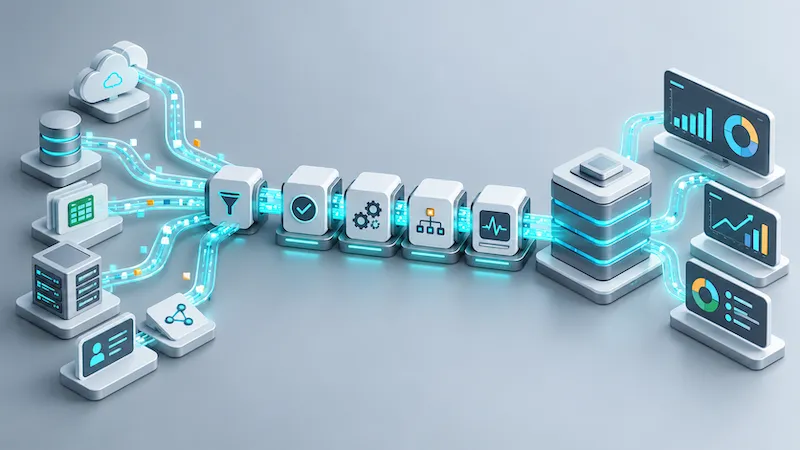
Many companies already have the data they need, but they cannot use it in time. Information is scattered across spreadsheets, business platforms, databases, emailed files, and third-party APIs. Each department prepares its own reports and applies different rules. By the time the numbers finally match, the decision they were meant to support has already been delayed.
This leads to a reasonable question: does the company need a data pipeline? The answer depends less on volume than on the frequency, risk, and operating cost of the current process. One business may manage millions of records with a simple solution because the workflow is stable and infrequent. Another may need a pipeline at a much smaller scale because daily reports depend on manual tasks, changing formats, and sources that update at different times.
A pipeline becomes justified when moving, validating, and preparing data stops being an occasional task and becomes an operational capability that must work repeatedly. If the problem can still be solved with a scheduled query, managed connector, or small automation, building a complete platform may add cost and maintenance without providing meaningful control.
Short answer: A business needs a data pipeline when it must integrate data repeatedly, apply consistent rules, detect failures, and deliver information within a predictable timeframe. It probably does not need one when the workflow is occasional, low-risk, and manageable through a simpler solution.
What a Data Pipeline Means in Business Terms
A data pipeline is an automated, repeatable process that collects information from one or more sources, verifies its quality and structure, transforms it according to defined rules, and delivers it somewhere it can be used.
The destination could be a data warehouse, dashboard, operational application, report, file, or API consumed by another system.
The important word is repeatable. Downloading a file once to answer a question does not require a data platform. The need for a pipeline appears when the organization expects the same workflow to run regularly, produce consistent results, and report when the data does not meet the expected conditions.
From a business perspective, a pipeline should perform four responsibilities:
- Collect and move data from the correct sources.
- Apply cleaning, normalization, and transformation rules consistently.
- Verify data quality, freshness, and completeness before publication.
- Record each execution and alert the team when something fails.
The specific technology comes later. Python, SQL, BigQuery, DuckDB, MotherDuck, and orchestration tools can all be part of the solution, but none of them replaces the need to define the sources, rules, responsibilities, and expected business outcome.
Signs That the Current Process Is No Longer Enough
Data volume is not the only reason to build a pipeline. Frequency, manual effort, the consequences of failure, and the time available to produce the result can be more important.
The following situations can indicate that an informal process is becoming an operational risk.
Manual Consolidation Keeps Repeating
Every week, someone downloads the same files, copies columns between spreadsheets, corrects dates, and combines results before updating a report.
The process may work for months, but it depends on that person’s availability, memory, and attention. It also consumes time that could be spent interpreting the information and making decisions.
Repetition does not mean that the company immediately needs a complex platform. It does indicate that the workflow should be documented and considered for automation. If the result affects billing, inventory, campaigns, compliance, or daily decisions, it should also include validation, execution logs, and failure alerts.
Reports Do Not Agree
Sales reports one figure, finance reports another, and marketing presents a third. This does not necessarily mean that one team is wrong. Each result may use a different definition, period, or filter.
The problem appears when those differences are undocumented and nobody can reproduce how each figure was calculated.
A well-designed pipeline applies consistent rules or explicitly identifies when multiple definitions must coexist. The goal is not to force the entire company to use one table. It is to make every important metric traceable to its source, transformations, and responsible owner.
Information Lives in Multiple Systems
A CRM, ERP, payment platform, advertising account, analytics tool, internal application, and spreadsheet may each describe a different part of the same process.
Answering a seemingly simple question may require reconciling identifiers, time zones, currencies, customer names, and statuses represented differently by each system.
When this integration becomes repetitive, manual exports become fragile. A pipeline can separate the extraction of each source, preserve the original data, and apply matching rules that can be tested and changed.
Errors Are Discovered Too Late
A dashboard can look normal even when an API stops returning a category, a column changes its type, or an entire day of data is missing.
If the first warning comes from a meeting, a client, or a decision-maker, the process needs controls before publication.
Validations can check required fields, unique identifiers, expected formats, relationships, minimum volumes, and unexpected changes. The objective is not to guarantee perfect data. It is to stop known failures from silently becoming official information.
Delivery Time Affects Decisions
A company may accept a monthly report that takes two days to prepare but cannot tolerate the same delay when adjusting inventory or monitoring an active campaign.
The required frequency should be defined by the decision, not by the technical ability to process everything in real time.
If the business needs the information before a specific hour, the pipeline should finish before that deadline and alert the team when it does not.
Knowledge Is Concentrated in One Person
Some processes work because one person remembers the exact order of the files, knows which rows must be excluded, and understands how to repair each error.
Until that knowledge is documented and automated, the risk does not depend on data volume. It depends on the absence of an operational replacement.
When a Simpler Solution Is Enough
Not every data problem requires a complete platform. A sophisticated pipeline introduces deployments, credentials, monitoring, support, cost controls, and the need to respond when something fails.
The solution should match the actual risk and complexity of the process.
A simpler approach is usually sufficient when several of these conditions apply:
- The data comes from one stable source or a few sources that are easy to integrate.
- The process runs infrequently, and a delay does not affect operations.
- The volume can be managed using tools the team already understands.
- The transformations are limited, explainable, and easy to review.
- The result supports a one-time analysis instead of a critical process.
- The source offers a managed connector that already covers the requirements.
- The business rules are still changing and should be validated before becoming permanent.
- A failure can be identified and corrected manually without causing financial loss, noncompliance, or incorrect decisions.
In these cases, a scheduled query, managed connector, small Python script, or cloud function may be enough.
Even the smallest solution should protect credentials, handle errors, record executions, and provide a clear way to rerun the process. Simple should not mean improvised or dependent on one person’s memory.
A Decision Framework for Choosing the Smallest Effective Solution
Start with the simplest option that can meet the required reliability, security, and delivery time. Add complexity only when a specific operational requirement justifies it.
1. The Process Uses an Occasional File
Start with: a template, query, or script executed on demand.
Consider expanding when: the process becomes repetitive, affects an important operation, or becomes difficult to reproduce.
2. One Source Needs a Daily Update
Start with: a scheduled task with basic validation, error handling, and execution logging.
Consider expanding when: the workflow requires automated retries, recovery of incomplete periods, dependencies, or multiple consumers.
3. Several Stable Sources Must Be Integrated
Start with: a batch pipeline that preserves the original data, applies defined transformations, and monitors the result.
Consider expanding when: the number of sources, dependencies, consumers, or required executions increases.
4. The Business Needs Faster Information
Start with: defining how much delay the operation can actually tolerate and determining whether several scheduled updates during the day are sufficient.
Consider expanding when: a response measured in seconds or minutes produces a demonstrable operational benefit. Event-based integration or streaming may then be justified.
5. Teams Use Different Metrics
Start with: agreeing on definitions, periods, filters, and ownership.
Consider expanding when: those rules have been approved and need to be applied consistently. Automating before reaching agreement only reproduces the disagreement faster.
6. The Process Has No Defined Owner
Start with: assigning responsibility for reviewing executions, responding to alerts, and approving changes.
Consider expanding when: the organization has the capacity to operate and maintain the solution. No tool removes the need for ownership and support.
Anatomy of a Maintainable Data Pipeline
Not every pipeline needs the same components. A maintainable architecture separates responsibilities so that failures can be identified, corrected, and recovered without rebuilding the entire process.
Sources and Ingestion
Ingestion collects data from APIs, databases, files, queues, or internal applications. It should respect the limits of each source, preserve checkpoints, and avoid duplicating information when an execution is repeated.
Credentials should be managed outside the application code.
When external platforms are primary data sources, reliable API integration must account for authentication, pagination, rate limits, structural changes, retries, and incomplete executions.
Original Data Layer
Keeping a controlled copy of the data as it arrived makes it possible to investigate changes and reprocess previous periods.
This does not always require a large data lake. The same principle can be applied to smaller storage with clearly defined names, dates, permissions, and retention rules.
Validation
Before transforming information, the pipeline should verify the basic contract of each source:
- Did the expected columns arrive?
- Are the dates valid?
- Is the primary identifier present?
- Is the volume within an expected range?
- Are required files or periods missing?
The rules should distinguish between failures that block publication and warnings that require review.
Transformation and Modeling
Transformation standardizes formats and units, removes duplicates, calculates fields, and connects related entities.
The final model should support specific business decisions. Building dozens of tables without defined consumers increases the maintenance surface without guaranteeing value.
Delivery
Data may be delivered to a dashboard, analytical table, operational application, file, or API.
Each consumer should understand the expected update frequency, availability conditions, and meaning of the fields it uses.
Observability and Recovery
The pipeline should record its start time, completion time, duration, number of processed records, and reason for failure.
It also needs controlled retries and a process for recovering incomplete executions. A workflow that operates only when everything goes perfectly is still fragile.
ETL and ELT Without Letting the Acronym Make the Decision
In ETL, data is extracted, transformed, and then loaded into the destination. In ELT, data is extracted, loaded first, and transformed inside the analytical system.
Both strategies are valid. Neither is automatically better.
The choice depends on the sensitivity of the information, the capacity of the destination, processing costs, the need to preserve original data, and where the team can best test and maintain the transformation rules.
A single workflow can also combine both approaches. For example, sensitive information may be validated and anonymized before loading, while analytical modeling happens afterward.
The architecture should explain why each transformation occurs at a particular stage instead of selecting an acronym because it is popular.
Example Architecture for Fragmented Business Data
Consider a company that needs to consolidate sales, payment, advertising, and operational information. The data comes from an ERP, CRM, advertising platforms, and files submitted by external providers.
A pipeline for this situation could work as follows:
- Each connector retrieves only the changes produced since the last confirmed execution and preserves a copy of the original response.
- The validation stage checks the structure, dates, identifiers, and received volume before continuing.
- Transformations standardize customers, campaigns, currencies, and reporting periods using documented and versioned rules.
- The analytical repository separates original data, prepared data, and models ready for consumption.
- Dashboards query stable models instead of combining sources independently inside every visualization.
- Monitoring generates an alert when a source does not update, a validation fails, or the workflow misses its agreed completion time.
For a small operation, this architecture could use scheduled Python tasks and an analytical engine such as DuckDB. Larger or more collaborative requirements may justify a managed warehouse such as BigQuery or MotherDuck together with an orchestration tool.
The selection should be based on actual volume, frequency, budget, and the team’s ability to operate the solution—not on the popularity of a platform.
When an organization needs to integrate recurring sources, enforce data quality controls, and deliver trustworthy analytical models, specialized data engineering services can help define the workflow, architecture, and operating responsibilities.
Data Quality That Can Be Verified
Data quality should not be reduced to confirming that the process finished. A pipeline can complete every technical task and still publish incomplete, outdated, or incorrect information.
Useful checks usually cover:
- Freshness: the data corresponds to the period expected by the consumer.
- Completeness: all required files, periods, or records arrived.
- Uniqueness: identifiers that should be unique were not duplicated.
- Validity: dates, amounts, statuses, and codes match defined formats and ranges.
- Referential integrity: essential relationships between records can be resolved.
- Reconciliation: quantities and totals match the source within an agreed tolerance.
- Variation: unexpected changes in volume or distribution generate an alert.
Every rule needs an owner and an associated action. An alert that nobody handles does not protect the data, but an unnecessary block can also delay operations.
Controls should therefore be divided into errors that stop publication, warnings that allow the process to continue, and metrics used to observe trends.
Ownership and Documentation
The pipeline should remain maintainable without depending entirely on the memory of the person who built it.
At minimum, the documentation should include:
- Data sources and their business owners.
- Required permissions and credential rotation procedures, without exposing secrets.
- The structure and meaning of important fields.
- Transformation rules and architectural decisions.
- Expected frequency and execution windows.
- Recovery and reprocessing procedures.
- Monitoring dashboards, alerts, and response responsibilities.
- Operating costs and limits that require review.
Documentation also protects system ownership. The organization should understand how its data moves, where it is stored, and what is required to operate the solution if the provider or responsible team changes.
Costs to Evaluate Before Building
The cost of a pipeline does not end when the first report works. The evaluation should include development, infrastructure, storage, data transfer, monitoring, support, API changes, quality corrections, and team training.
Complexity increases when tools are introduced to solve problems the company does not yet have. Distributed orchestration, real-time processing, and multiple storage layers may be appropriate for demanding operations. For a daily workflow with only a few sources, they may turn a manageable automation into a difficult platform.
A useful decision compares the total cost of the solution with the current cost of manual work, errors, delays, reprocessing, and decisions made with incomplete information.
If the expected benefit cannot be explained in those terms, the problem probably needs further definition.
How to Implement Without Overengineering
A gradual implementation makes it possible to verify value before expanding the architecture:
- Define the decision that needs the data and the latest acceptable delivery time.
- Document the current process, including manual steps and known exceptions.
- Select a workflow with clear value and enough stability to become a pilot.
- Define source expectations, data-quality rules, and acceptance criteria.
- Build the smallest complete path from the source to a real consumer.
- Run the new process alongside the current workflow and compare the results for an agreed period.
- Document operation, recovery, ownership, and costs before retiring the previous process.
- Expand the architecture only when new requirements have been verified.
This approach reduces risk and prevents the first version from attempting to integrate every source in the organization before demonstrating that the model works.
Initial Assessment Checklist
Before choosing tools or estimating an implementation, answer the following questions:
- What are the data sources, and who will consume the results?
- How much time is spent downloading, cleaning, and consolidating information?
- Which errors occur frequently, and what is their operational impact?
- How often are the results actually needed?
- How much delay can the operation tolerate?
- What do the critical metrics mean, and who approves their definitions?
- Which information is sensitive, and what permissions does it require?
- Could a managed connector or simpler automation already solve the problem?
- Which validations and alerts are necessary?
- How will an incomplete execution be recovered?
- What will development, infrastructure, support, and training cost?
- Which workflow can serve as a pilot with a verifiable outcome?
Not every answer needs to exist on the first day. However, unanswered questions should be recognized as risks or pending decisions.
When Specialized Support Makes Sense
Specialized support can be useful when several departments depend on the process, source systems change frequently, sensitive information is involved, or the internal team does not have the capacity to design and operate the workflow.
A responsible assessment should begin with the decisions that need the data, the available sources, the business rules, and the operational risks. The tools should be selected afterward.
Cooltimedia helps organizations consolidate information, automate recurring workflows, and retain control of their architecture through data engineering and API integration.
Evaluate the Workflow Before Choosing the Architecture
Does your team spend too much time collecting, correcting, and comparing data before it can be used?
Cooltimedia can help you review the sources, frequency, risks, and business decisions that depend on that information. From that assessment, we can determine whether the right next step is a data pipeline, a targeted integration, or a simpler automation.
Frequently Asked Questions
Does Excel Stop Being Useful When a Business Needs a Pipeline?
Not necessarily. Excel can remain useful for reviewing, analyzing, or presenting information.
The problem appears when it becomes the main mechanism for integrating sources, applying critical rules, and preserving history without version controls or validation. A pipeline can prepare dependable data and deliver a file that the team continues using in Excel.
What Is the Difference Between Automation and a Data Pipeline?
Automation executes a task without manual intervention. A pipeline organizes multiple stages for collecting, validating, transforming, and delivering data.
A scheduled script can be a small pipeline if it performs those responsibilities and includes appropriate monitoring and recovery.
Is ETL Better Than ELT?
There is no universal answer. ETL can be appropriate when information must be cleaned, validated, or protected before entering the destination.
ELT can take advantage of an analytical warehouse and preserve original data for future transformations. The decision should consider security, cost, technical capacity, and maintainability.
Do All Data Pipelines Need to Operate in Real Time?
No. Real-time processing adds cost and complexity.
If a decision is made once per day, a dependable batch process that finishes before the required time is usually sufficient. Frequency should be based on the operational requirement, not on the technical possibility of processing data continuously.
How Much Does a Data Pipeline Cost?
The cost depends on the number and stability of the sources, frequency, volume, quality rules, security requirements, existing tools, and required level of support.
The assessment should divide the work into individual workflows and compare the solution’s cost with the manual work, errors, delays, and risks it will replace.
How Long Does It Take to Build?
A small workflow with stable sources can be validated relatively quickly. A platform involving legacy systems, sensitive information, and several consumers requires more discovery, coordination, and testing.
The implementation should be estimated in stages, beginning with one complete path from a source to a real consumer.
How Is Sensitive Information Protected?
The architecture should apply least-privilege access, encryption in transit and at rest, environment separation, secure credential management, retention controls, and access logging.
Whenever possible, personal information should be minimized, anonymized, or excluded from analytical layers that do not need it.

Jair Manuel Poveda Frago
Python & Django Engineer
Desarrollador Python y Django, fundador de Cooltimedia y profesor universitario. Especialista en arquitectura de software, IA y soluciones de datos. Conecto la ingeniería aplicada en proyectos reales con la docencia universitaria, compartiendo aprendizajes sobre desarrollo profesional, automatización y buenas prácticas de ingeniería.